Polygon zkEVM in 2026: Adoption, Scalability, and Ethereum’s Future

Polygon zkEVM is expected to achieve substantial adoption by 2026, providing robust scalability for Ethereum through its zero-knowledge technology, significantly improving transaction efficiency and cost-effectiveness.
By 2026, the landscape of blockchain scalability is set to be significantly shaped by solutions like Polygon zkEVM Adoption, offering a critical pathway for Ethereum to handle increasing demand. This article delves into how this innovative technology is poised to transform decentralized applications and the broader crypto ecosystem.
Understanding Polygon zkEVM’s Core Technology
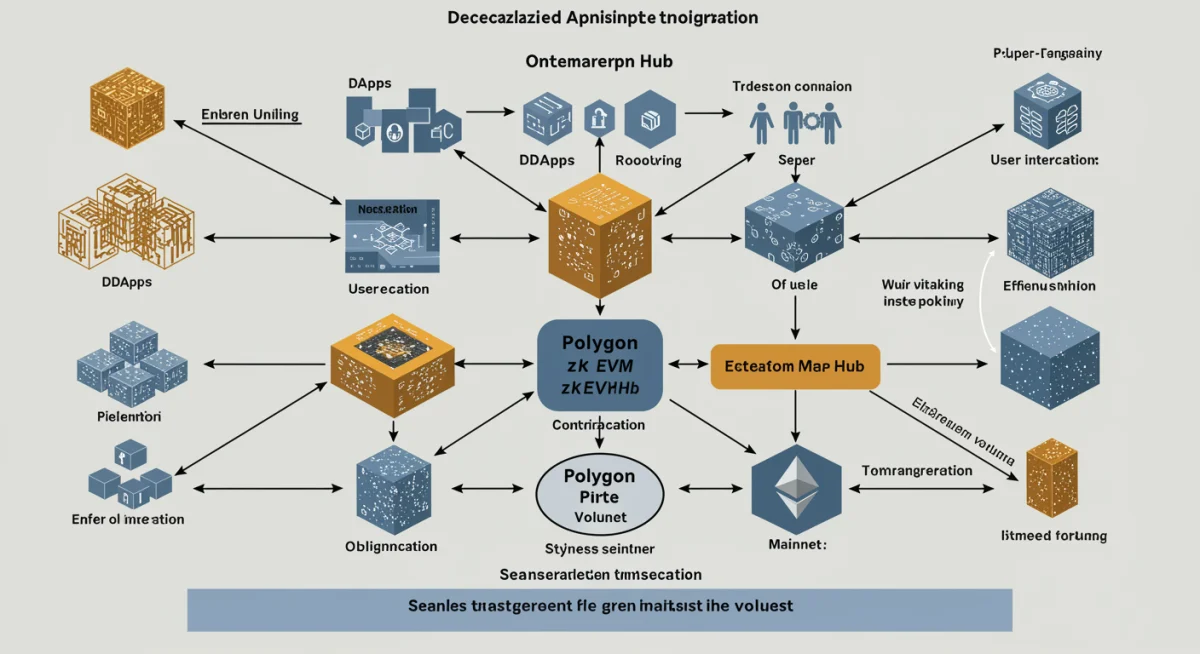
Polygon zkEVM represents a monumental leap in scaling Ethereum, leveraging zero-knowledge proofs to bundle numerous transactions off-chain, then submitting a single, cryptographically verified proof to the Ethereum mainnet. This approach dramatically enhances throughput and reduces transaction costs without compromising security. Its compatibility with the Ethereum Virtual Machine (EVM) means developers can migrate existing dApps with minimal changes, accelerating adoption.
The core innovation lies in its ability to execute smart contracts in a manner identical to Ethereum, yet with the immense benefits of ZK-rollups. This ensures that the security guarantees of Ethereum are inherited, while the operational burden is significantly lightened. For many, zkEVM is not just an upgrade; it’s the future of scalable blockchain infrastructure.
The Mechanics of ZK-Rollups
ZK-rollups are cryptographic protocols that allow for the efficient verification of batches of transactions. Instead of verifying each transaction individually on the main chain, a cryptographic proof (a zero-knowledge proof) is generated for the entire batch. This proof confirms the validity of all transactions without revealing their details, ensuring privacy and efficiency.
- Transaction Aggregation: Multiple transactions are batched together off-chain.
- Zero-Knowledge Proof Generation: A succinct cryptographic proof is created for the entire batch.
- On-Chain Verification: Only the proof is submitted and verified on the Ethereum mainnet.
- Reduced Costs: Lower gas fees due to fewer on-chain interactions.
The implications of this technology are profound, as it addresses the long-standing challenges of network congestion and high transaction fees that have plagued Ethereum. By providing a scalable, secure, and EVM-compatible environment, Polygon zkEVM sets the stage for a new era of decentralized applications.
Anticipated Adoption Rate by 2026
The adoption rate of Polygon zkEVM by 2026 is projected to be substantial, driven by its technical superiority and the increasing demand for scalable blockchain solutions. Developers and projects grappling with Ethereum’s limitations are actively seeking alternatives that maintain compatibility while offering performance enhancements. Polygon zkEVM fits this need perfectly, bridging the gap between Ethereum’s robust security and the necessity for high throughput.
Several factors will contribute to this accelerated adoption. The first is the growing maturity of zero-knowledge proof technology, which is becoming more robust and easier for developers to integrate. Second, the strong backing from the Polygon ecosystem and its established network of developers and users provides a fertile ground for new projects to flourish on zkEVM. Early success stories and demonstrable performance improvements will further catalyze this trend.
Key Drivers for Adoption
The push for widespread adoption is fueled by both technical advantages and market demand. As more users flock to decentralized applications, the need for efficient infrastructure becomes paramount. Polygon zkEVM offers a compelling solution that addresses these pressures head-on.
- Developer Familiarity: EVM compatibility reduces the learning curve for Ethereum developers.
- Lower Transaction Costs: Significant reduction in gas fees makes dApps more accessible.
- Increased Throughput: Higher transaction processing capabilities support larger user bases.
- Ecosystem Support: Strong community and development resources from Polygon Labs.
Moreover, strategic partnerships and integrations with major DeFi protocols and enterprise solutions will play a crucial role. As these larger entities begin to leverage Polygon zkEVM, it will create a network effect, drawing in more projects and users. The ease of migration from existing Ethereum dApps will be a significant incentive, allowing projects to scale without a complete overhaul of their codebase.
Scalability Solutions for Ethereum
Polygon zkEVM stands as one of the most promising scalability solutions for Ethereum, offering a pathway to significantly enhance transaction capacity and efficiency. Ethereum’s foundational security and decentralization are unparalleled, but its current architecture limits its ability to process a high volume of transactions concurrently without incurring high gas fees. This is where Layer 2 solutions, particularly ZK-rollups like Polygon zkEVM, become indispensable.
The solution works by offloading the computational burden from the main Ethereum chain. Instead of every node on Ethereum processing every transaction, Polygon zkEVM handles the bulk of the processing off-chain. It then periodically submits a compressed, cryptographically verified summary of these transactions to Ethereum. This summary, proven by a zero-knowledge proof, is much smaller and cheaper to verify than individual transactions, thereby scaling the entire network.
Comparison with Other Layer 2 Solutions
While various Layer 2 solutions exist, such as optimistic rollups and sidechains, zkEVMs offer distinct advantages, particularly in terms of security and finality. Optimistic rollups, for instance, have a challenge period during which transactions can be disputed, leading to longer withdrawal times. ZK-rollups, on the other hand, provide immediate finality because the validity of transactions is cryptographically proven.
Sidechains, while offering high throughput, often rely on their own security mechanisms, which may not be as robust as Ethereum’s. Polygon zkEVM’s direct inheritance of Ethereum’s security model makes it a more secure and trust-minimized scaling solution. This combination of security, scalability, and EVM compatibility positions Polygon zkEVM as a leading contender in the race to scale Ethereum.
The continuous development and optimization of zero-knowledge proof technology will further enhance its capabilities, making it even more efficient and cost-effective. As these improvements roll out, the appeal of Polygon zkEVM as the primary scaling layer for Ethereum will only grow stronger, solidifying its role in the future of decentralized finance and web3.
Impact on Decentralized Applications (dApps)
The advent of Polygon zkEVM is set to revolutionize the landscape of decentralized applications, opening doors for innovative use cases that were previously hindered by Ethereum’s scalability limitations. Developers can now build and deploy complex dApps with the assurance of high transaction throughput and significantly lower operational costs. This will be particularly impactful for applications requiring frequent interactions, such as gaming, social media platforms, and high-frequency trading.
For existing dApps, migrating to Polygon zkEVM offers a clear path to enhanced performance and user experience. Users will benefit from faster transaction confirmations and reduced gas fees, making dApps more accessible and enjoyable. This improved user experience is crucial for mainstream adoption, as it removes one of the biggest barriers to entry for new users in the blockchain space.
New Possibilities for Developers
The EVM compatibility of Polygon zkEVM is a game-changer for developers. They can leverage their existing Solidity knowledge and tools, minimizing the need for extensive retraining or rewriting of codebases. This ease of migration significantly lowers the barrier to entry for developing scalable dApps.
- Gaming: Enables complex in-game economies and fast, cheap transactions for NFTs.
- DeFi: Supports high-frequency trading, micro-lending, and sophisticated financial instruments.
- Social Media: Facilitates real-time interactions and content monetization without high fees.
- Enterprise Solutions: Provides a robust and scalable infrastructure for blockchain-based business applications.
Furthermore, the increased capacity allows for more sophisticated smart contract designs and interactions, fostering a new wave of innovation. Developers can experiment with more intricate logic and larger data sets, pushing the boundaries of what’s possible on a decentralized network. This will lead to a richer and more diverse ecosystem of dApps, ultimately benefiting end-users with more powerful and efficient applications.
Challenges and Opportunities for Polygon zkEVM
While the future of Polygon zkEVM looks promising, it is not without its challenges. The complexity of zero-knowledge proof technology requires specialized expertise, which can be a bottleneck for broader developer adoption. Optimizing the prover efficiency and reducing the cost of generating proofs are ongoing areas of research and development. Ensuring the security and stability of the network as it scales will also be a continuous effort, requiring rigorous audits and constant vigilance.
However, these challenges also present significant opportunities. As the technology matures and developer tools become more user-friendly, the barrier to entry will decrease. Innovations in hardware acceleration for proof generation could drastically improve efficiency. Furthermore, the strong community and financial backing of Polygon Labs mean that resources are continually being poured into addressing these technical hurdles, fostering a robust and resilient ecosystem.
Overcoming Technical Hurdles
The journey to mass adoption involves significant technical refinements. The efficiency of zero-knowledge proof generation, for instance, is a critical factor impacting transaction finality and cost. Ongoing research aims to make these proofs even more compact and faster to compute.
- Prover Optimization: Continuous efforts to make proof generation faster and more cost-effective.
- Developer Tooling: Improving SDKs, frameworks, and documentation to simplify dApp development.
- Security Audits: Regular and thorough audits to ensure the integrity and robustness of the protocol.
- Interoperability: Enhancing seamless communication with other blockchain networks.
The opportunity for Polygon zkEVM lies in becoming the de facto standard for EVM-compatible ZK-rollups. By consistently delivering on its promises of scalability and security, it can establish a dominant position in the Layer 2 landscape. The network effects of attracting a critical mass of developers and users will create a virtuous cycle, accelerating its growth and solidifying its role as a cornerstone of the Ethereum ecosystem.
The Future Landscape of Ethereum with zkEVM
By 2026, the integration of Polygon zkEVM is expected to fundamentally alter the future landscape of Ethereum, transforming it into a multi-layered, highly scalable network capable of supporting a global user base. Ethereum’s mainnet will increasingly serve as a secure settlement layer, while Polygon zkEVM and similar Layer 2 solutions handle the vast majority of transaction processing. This modular approach will allow Ethereum to maintain its core principles of decentralization and security, while effectively addressing the demands for speed and affordability.
This symbiotic relationship will foster an environment where innovation can thrive without being constrained by network limitations. New applications, from advanced DeFi protocols to metaverse experiences, will become feasible, driving the next wave of blockchain adoption. The vision of a truly decentralized and accessible internet, powered by Ethereum, moves closer to reality with the widespread deployment of zkEVM technology.

Long-Term Vision and Synergy
The long-term vision for Ethereum involves a robust ecosystem of Layer 2 solutions, with Polygon zkEVM playing a pivotal role. This synergy will enable Ethereum to scale horizontally, supporting an unprecedented number of users and transactions, far beyond what a monolithic blockchain could achieve.
- Enhanced User Experience: Faster transactions and lower fees for all dApp users.
- Sustainable Growth: A scalable infrastructure that can accommodate future demand.
- Increased Innovation: Developers empowered to build more complex and ambitious applications.
- Decentralized Future: Strengthening Ethereum’s role as the backbone of a decentralized internet.
The ongoing commitment to research and development in zero-knowledge technology, combined with community collaboration, will ensure that Polygon zkEVM continues to evolve and adapt to the ever-changing needs of the blockchain space. Its success will not only benefit the Polygon ecosystem but will also be instrumental in securing Ethereum’s position as the leading smart contract platform for decades to come, ushering in an era of unparalleled growth and utility for decentralized technologies.
| Key Aspect | Brief Description |
|---|---|
| Core Technology | Leverages ZK-rollups for off-chain transaction processing with on-chain proof verification, ensuring Ethereum security. |
| Adoption Drivers | EVM compatibility, reduced costs, increased throughput, and strong Polygon ecosystem support. |
| Scalability Impact | Significantly enhances Ethereum’s transaction capacity and efficiency, acting as a secure settlement layer. |
| Future Outlook | Poised to enable next-gen dApps, transforming Ethereum into a highly scalable, modular network. |
Frequently Asked Questions About Polygon zkEVM
Polygon zkEVM is a Layer 2 scaling solution for Ethereum that uses zero-knowledge proofs to process transactions off-chain. It batches transactions, generates a cryptographic proof of their validity, and then submits this single proof to the Ethereum mainnet, drastically increasing throughput and reducing gas fees while maintaining security.
It will significantly improve dApp development by offering an EVM-compatible environment, allowing easy migration for existing projects. Users will experience faster transaction finality and much lower costs, making complex dApps like games and DeFi protocols more accessible and enjoyable for a broader audience.
Its primary advantages include immediate transaction finality due to cryptographic proofs, direct inheritance of Ethereum’s robust security, and full EVM compatibility. Unlike optimistic rollups, it doesn’t require a challenge period, and it offers stronger security guarantees than many sidechains.
Key challenges include the technical complexity of zero-knowledge proofs, which can be a barrier for some developers, and the ongoing need to optimize prover efficiency. Additionally, ensuring continuous security and stability as the network grows requires persistent development and auditing efforts.
Polygon zkEVM helps transform Ethereum into a modular, highly scalable network where the mainnet acts as a secure settlement layer. This enables Ethereum to support a vast number of users and transactions, fostering innovation and making the decentralized internet a more practical reality for global adoption.
Conclusion
By 2026, Polygon zkEVM is poised to be a cornerstone of Ethereum’s scalability strategy, driving significant adoption across the decentralized ecosystem. Its ability to combine robust security with high transaction throughput and EVM compatibility positions it as a critical enabler for the next generation of dApps. While challenges remain in technical optimization and developer education, the ongoing innovation and strong community support suggest a future where Polygon zkEVM plays a pivotal role in making blockchain technology truly accessible and efficient for a global audience.