Bitcoin’s 6-Month Performance: Dollar Dynamics & Economic Shifts

Analyzing Bitcoin’s 6-month performance against the U.S. dollar reveals a complex interplay of macroeconomic factors, regulatory shifts, and evolving investor sentiment within a dynamic global economic environment.
Understanding the trajectory of Bitcoin 6-Month Performance against the U.S. dollar is crucial for investors and enthusiasts alike. In an ever-evolving global economic landscape, how has the premier cryptocurrency fared, and what factors have shaped its journey over the past half-year?
The Macroeconomic Tapestry and Bitcoin’s Resilience
The past six months have presented a multifaceted macroeconomic environment, characterized by persistent inflation, fluctuating interest rates, and geopolitical tensions. These factors have undeniably influenced traditional financial markets, and by extension, the highly interconnected cryptocurrency space. Bitcoin, often touted as a hedge against inflation or a ‘digital gold,’ faces continuous scrutiny regarding its ability to maintain value during economic uncertainty.
Central bank policies, particularly those of the U.S. Federal Reserve, have played a pivotal role. Decisions on interest rate hikes, quantitative tightening, and fiscal stimulus directly impact the availability of capital and investor risk appetite. High interest rates, for instance, tend to make traditional, less volatile assets more attractive, potentially drawing capital away from speculative assets like Bitcoin. Conversely, periods of quantitative easing can inject liquidity into the system, sometimes benefiting risk assets.
Inflationary Pressures and Investor Sentiment
Global inflation rates have remained a significant concern, pushing central banks to adopt hawkish stances. While some argue Bitcoin could serve as an inflation hedge due to its limited supply, its price volatility often overshadows this narrative in the short term. Investor sentiment, therefore, becomes a critical determinant, reacting swiftly to inflation reports and economic forecasts.
- Interest Rate Hikes: Federal Reserve policy directly impacts the cost of borrowing and the attractiveness of fixed-income investments.
- Inflation Data: Consumer Price Index (CPI) and Producer Price Index (PPI) releases often trigger immediate market reactions.
- Geopolitical Events: Conflicts and political instability can drive investors towards or away from perceived safe-haven assets, including Bitcoin.
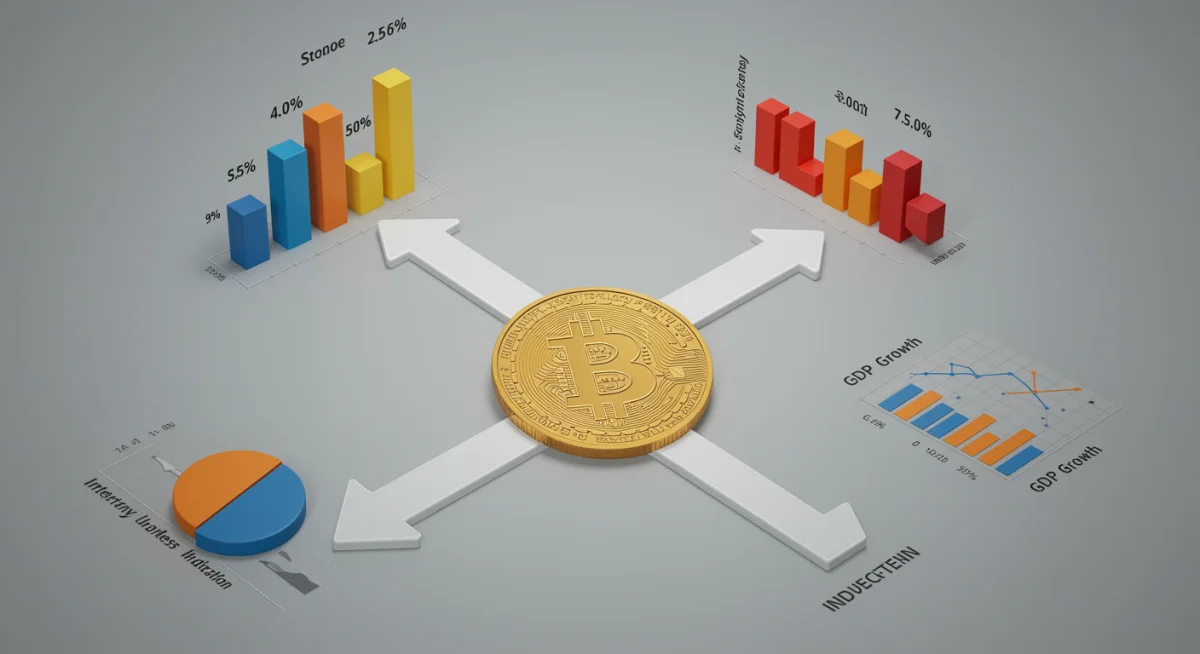
- Economic Growth Projections: GDP forecasts and employment figures offer insights into the overall health of the economy, influencing market confidence.
Ultimately, Bitcoin’s resilience in this macroeconomic tapestry is a testament to its evolving role in the global financial system. While it experiences significant fluctuations, its underlying technology and growing adoption continue to attract a dedicated base of investors who believe in its long-term value proposition, even amidst challenging economic headwinds.
U.S. Dollar Strength and Bitcoin’s Inverse Correlation
The U.S. dollar’s performance against other major global currencies has historically shown an inverse relationship with Bitcoin. When the dollar strengthens, it often puts downward pressure on Bitcoin’s price, and vice-versa. This dynamic is rooted in several factors, including global liquidity, safe-haven demand, and the dollar’s role as the primary reserve currency.
Over the past six months, periods of significant dollar strength, often driven by aggressive Fed rate hikes and global economic uncertainty, have coincided with corrections or consolidation phases for Bitcoin. Investors seeking safety tend to flock to the dollar during times of turmoil, viewing it as a reliable store of value. This capital reallocation can temporarily reduce demand for riskier assets like cryptocurrencies.
The Dollar Index (DXY) as a Bellwether
The Dollar Index (DXY), which measures the dollar’s value against a basket of six major currencies, serves as a key indicator. A rising DXY typically signals a stronger dollar, making dollar-denominated assets, including Bitcoin, more expensive for international buyers holding other currencies. This can lead to decreased demand and price depreciation.
- Flight to Safety: During global crises, the U.S. dollar often acts as a safe haven, attracting capital from riskier assets.
- Relative Value: A stronger dollar means that a fixed amount of Bitcoin represents less purchasing power for holders of other currencies, potentially impacting demand.
- Interest Rate Differentials: Higher U.S. interest rates compared to other nations can increase demand for dollar-denominated assets, strengthening the dollar.
The inverse correlation, however, is not absolute. Bitcoin’s unique characteristics and its own internal market dynamics can sometimes override the dollar’s influence. As the crypto market matures, its decoupling from traditional asset classes, including the dollar, remains a topic of ongoing debate and observation. Understanding this relationship is vital for forecasting Bitcoin’s short-to-medium term movements.
Shifting Regulatory Landscape and Institutional Adoption
Regulatory developments have cast a long shadow over the cryptocurrency market, influencing investor confidence and institutional participation. Over the last six months, various governments and regulatory bodies around the world have intensified their efforts to classify, control, and integrate digital assets into existing financial frameworks. These actions, ranging from new legislation to enforcement actions, significantly impact Bitcoin’s perceived legitimacy and future growth potential.
In the U.S., discussions around comprehensive crypto legislation have continued, with different agencies vying for jurisdiction. Clarity on how Bitcoin and other cryptocurrencies will be treated – as commodities, securities, or a new class of assets – is paramount for institutional investors who require regulatory certainty to allocate substantial capital. The absence of a unified framework often leads to hesitation and creates an environment of uncertainty.
Spot Bitcoin ETFs and Their Impact
A significant development impacting institutional adoption has been the ongoing saga of spot Bitcoin Exchange-Traded Funds (ETFs). The approval or rejection of such financial products by regulatory bodies like the SEC has substantial implications. An approved spot ETF would provide a more accessible and regulated avenue for traditional investors to gain exposure to Bitcoin, potentially unlocking massive inflows of capital. Conversely, continued delays or rejections can dampen enthusiasm and prolong the wait for broader institutional integration.
- Regulatory Clarity: Clear guidelines help institutions navigate the legal and compliance complexities of crypto investments.
- Institutional Inflows: Products like spot Bitcoin ETFs can open the floodgates for traditional financial institutions to invest directly in Bitcoin.
- Global Harmonization: International cooperation on crypto regulation could create a more stable and predictable global market.
The interplay of regulatory shifts and the pace of institutional adoption will continue to be a defining factor in Bitcoin’s performance. As more robust frameworks emerge, the digital asset class is likely to gain further legitimacy, attracting a broader base of investors and potentially reducing some of its inherent volatility. However, the path to comprehensive regulation remains complex and often contentious.

Technological Advancements and Network Health
Beyond macroeconomic and regulatory factors, Bitcoin’s intrinsic value and its network’s health play a crucial role in its long-term performance. Over the past six months, continuous technological advancements, network upgrades, and the robustness of the underlying blockchain infrastructure have reinforced Bitcoin’s position as a leading digital asset. These developments ensure the network remains secure, efficient, and capable of handling increasing demand.
Key metrics such as hash rate, transaction volume, and active addresses provide insights into the network’s vitality. A rising hash rate indicates increased security and miner participation, while sustained transaction volume and growing active addresses suggest continued utility and user adoption. These on-chain metrics often serve as fundamental indicators, offering a more granular view of Bitcoin’s health independent of speculative price movements.
Scaling Solutions and Future Potential
Efforts to enhance Bitcoin’s scalability, primarily through the Lightning Network, have continued to progress. The Lightning Network enables faster and cheaper transactions, making Bitcoin more viable for everyday use cases beyond simply a store of value. These layer-2 solutions are critical for Bitcoin to compete with other payment networks and to achieve broader mainstream adoption.
- Hash Rate Growth: A higher hash rate signifies a more secure and decentralized network, attracting confidence.
- Lightning Network Adoption: Increased use of layer-2 solutions enhances Bitcoin’s utility for micro-transactions.
- Developer Activity: Continuous development and improvement of the Bitcoin protocol ensure its adaptability and longevity.
- Mining Efficiency: Advancements in mining technology and renewable energy integration improve the network’s sustainability.
The ongoing commitment to technological innovation and the inherent strength of the Bitcoin network contribute significantly to its long-term value proposition. While market sentiment can drive short-term price action, the fundamental health and continuous improvement of the network provide a strong foundation for its future performance and its ability to withstand external pressures.
Market Sentiment, Speculation, and Volatility
Bitcoin’s price movements are heavily influenced by market sentiment and speculative trading, often leading to significant volatility. Over the past six months, we’ve observed periods of heightened enthusiasm followed by sharp corrections, reflecting the dynamic and often unpredictable nature of the cryptocurrency market. News events, social media trends, and the actions of large institutional players can all contribute to rapid shifts in sentiment.
Fear, uncertainty, and doubt (FUD) or conversely, fear of missing out (FOMO), are powerful psychological drivers in crypto markets. Negative news, such as regulatory crackdowns or exchange failures, can trigger widespread sell-offs. Conversely, positive developments, like major institutional investments or technological breakthroughs, can ignite rallies. This emotional component makes Bitcoin’s price action particularly susceptible to rapid swings.
Derivatives Market Influence
The growing derivatives market for Bitcoin, including futures and options, also plays a substantial role in price discovery and volatility. Large positions in these instruments can amplify price movements, as traders leverage their bets on future price direction. Liquidations of highly leveraged positions, in particular, can trigger cascading effects, leading to sharp price drops or surges.
- Social Media Trends: Online discussions and influencer opinions can quickly sway retail investor sentiment.
- News Events: Major announcements or incidents related to crypto can cause immediate price reactions.
- Whale Activity: Large transactions by significant holders can signal market shifts and influence smaller investors.
- Technical Analysis: Many traders rely on chart patterns and indicators, which can create self-fulfilling prophecies in the short term.
Navigating Bitcoin’s market requires a keen understanding of both fundamental drivers and the powerful forces of sentiment and speculation. While its underlying technology offers long-term promise, investors must be prepared for the inherent volatility that comes with a relatively young and rapidly evolving asset class, especially when considering its performance against established currencies like the U.S. dollar.
Bitcoin’s Correlation with Traditional Assets
The narrative around Bitcoin as an uncorrelated asset has evolved significantly over recent years. While initially seen as a distinct and independent asset, its correlation with traditional financial markets, particularly tech stocks and broader equity indices like the S&P 500, has become more pronounced. This increased correlation suggests that Bitcoin is increasingly being treated as a risk-on asset by institutional investors.
Over the past six months, periods of risk aversion in traditional markets, often triggered by concerns about inflation, interest rates, or economic slowdowns, have frequently seen Bitcoin decline alongside equities. This challenges the ‘digital gold’ thesis for some, highlighting that in times of significant uncertainty, investors may liquidate all risk assets, including cryptocurrencies, to move into cash or less volatile alternatives.
Diversification Benefits Re-evaluated
For investors seeking diversification, the fluctuating correlation with traditional assets presents a complex picture. While Bitcoin may offer some diversification benefits over longer time horizons, its short-to-medium term movements often mirror those of the broader equity market. This necessitates a more nuanced approach to portfolio construction and risk management for those incorporating digital assets.
- S&P 500 Correlation: Bitcoin’s price often moves in tandem with major U.S. stock indices during periods of market stress.
- Tech Stock Proxy: Some investors view Bitcoin as a proxy for the broader tech sector, linking its performance to innovation and growth narratives.
- Risk-On/Risk-Off Dynamics: Bitcoin tends to perform well during ‘risk-on’ periods and poorly during ‘risk-off’ shifts.
Ultimately, understanding Bitcoin’s evolving correlation with traditional assets is crucial for investors. As the market matures and institutional participation grows, these relationships are likely to continue to shift, requiring constant re-evaluation. The idea of Bitcoin as a completely independent asset is increasingly being challenged by its integration into the broader global financial ecosystem.
| Key Aspect | Brief Description |
|---|---|
| Macroeconomic Influence | Inflation, interest rates, and geopolitical events significantly shape Bitcoin’s price trajectory. |
| U.S. Dollar Dynamics | A strong dollar often correlates with downward pressure on Bitcoin, indicating a flight to safety. |
| Regulatory & Institutional Factors | Regulatory clarity and spot ETF approvals are crucial for broader institutional adoption and market stability. |
| Market Sentiment & Volatility | Speculation, news, and derivatives markets contribute to Bitcoin’s notable price swings. |
Frequently Asked Questions About Bitcoin’s Recent Performance
Rising U.S. interest rates, driven by Federal Reserve policies to combat inflation, have generally made traditional, less risky assets more appealing. This can divert capital from speculative assets like Bitcoin, contributing to periods of price consolidation or decline as investors seek higher yields in safer investments.
While Bitcoin’s limited supply supports its long-term inflation hedge narrative, its short-term price volatility often overshadows this. Over the past six months, its performance has been influenced more by risk-on/risk-off sentiment and macroeconomic factors, making its role as a consistent inflation hedge less clear in the immediate term.
Regulatory clarity significantly impacts Bitcoin’s price stability by influencing institutional adoption and market confidence. Uncertainty or restrictive regulations can deter large investors, leading to price volatility. Conversely, clear and favorable frameworks, such as spot ETF approvals, can attract substantial capital and foster greater stability.
Generally, a stronger U.S. dollar, often indicated by a rising Dollar Index (DXY), tends to exert downward pressure on Bitcoin’s price. This is because a stronger dollar makes dollar-denominated assets more expensive for international buyers and can signal a ‘flight to safety’ where investors move capital into the dollar during economic uncertainty.
Recent technological advancements, including continued growth in the network’s hash rate and advancements in layer-2 scaling solutions like the Lightning Network, have enhanced Bitcoin’s security and transaction efficiency. These improvements contribute to the network’s overall health and long-term viability, reinforcing its fundamental value proposition.
Conclusion
Analyzing Bitcoin’s 6-month performance against the U.S. dollar reveals a complex interplay of forces, ranging from global macroeconomic trends and regulatory shifts to intrinsic network developments and evolving market sentiment. Its journey through a shifting economic landscape underscores its increasing integration into the broader financial system, moving beyond a niche asset to one influenced by the same powerful currents that shape traditional markets. While its volatility remains a defining characteristic, the continued institutional interest, technological resilience, and the ongoing debate around its role as a hedge against inflation or a risk-on asset suggest that Bitcoin’s narrative is far from static. Investors and observers must continue to monitor these diverse factors to truly grasp the future trajectory of this groundbreaking digital asset.