

Anúncios
Identifying and mitigating the top 5 smart contract vulnerabilities in 2026 is paramount for US developers to ensure the integrity and security of decentralized applications, safeguarding digital assets and user trust.
The landscape of blockchain technology is constantly evolving, and with it, the complexities of securing smart contracts. For US developers, understanding and proactively addressing the most prevalent smart contract vulnerabilities in 2026 is not just good practice, it’s a fundamental requirement for building resilient and trustworthy decentralized applications (dApps). This expert analysis delves into the critical threats that demand immediate attention, offering insights into effective mitigation strategies.
Anúncios
Understanding the Evolving Threat Landscape in 2026
As smart contracts become more sophisticated and integrate with diverse real-world applications, the attack surface for malicious actors expands significantly. The financial stakes involved are higher than ever, making robust security a non-negotiable aspect of development. In 2026, we anticipate a continued rise in exploits targeting subtle logical flaws and intricate interaction patterns between contracts.
The increasing complexity of decentralized finance (DeFi) protocols, coupled with the introduction of novel blockchain architectures, presents new challenges. Developers must move beyond basic security checks and adopt a comprehensive, proactive approach to identifying potential weaknesses. This includes not only understanding known attack vectors but also anticipating emerging threats that leverage advancements in adversarial techniques.
The Shift Towards Sophisticated Attacks
Early smart contract exploits often targeted well-known vulnerabilities like reentrancy or integer overflows. While these remain relevant, attackers are now employing more sophisticated methods. They are focusing on cross-contract vulnerabilities, oracle manipulation, and intricate economic exploits that are harder to detect through traditional auditing alone. The learning curve for developers to stay ahead of these threats is steeper than ever.
Anúncios
- Cross-chain interaction risks: As interoperability grows, vulnerabilities in cross-chain bridges and communication protocols become critical targets.
- Economic exploits: Attacks that manipulate market conditions or protocol incentives to drain funds, often without directly breaching code.
- Supply chain attacks: Compromising libraries or dependencies used in smart contract development to inject malicious code.
The evolving threat landscape demands continuous education and adaptation from US developers. Staying informed about the latest attack methodologies and security best practices is crucial for protecting user assets and maintaining the integrity of the blockchain ecosystem. A strong foundation in secure coding principles is the first line of defense against these increasingly complex threats.
Reentrancy Attacks: A Persistent Threat
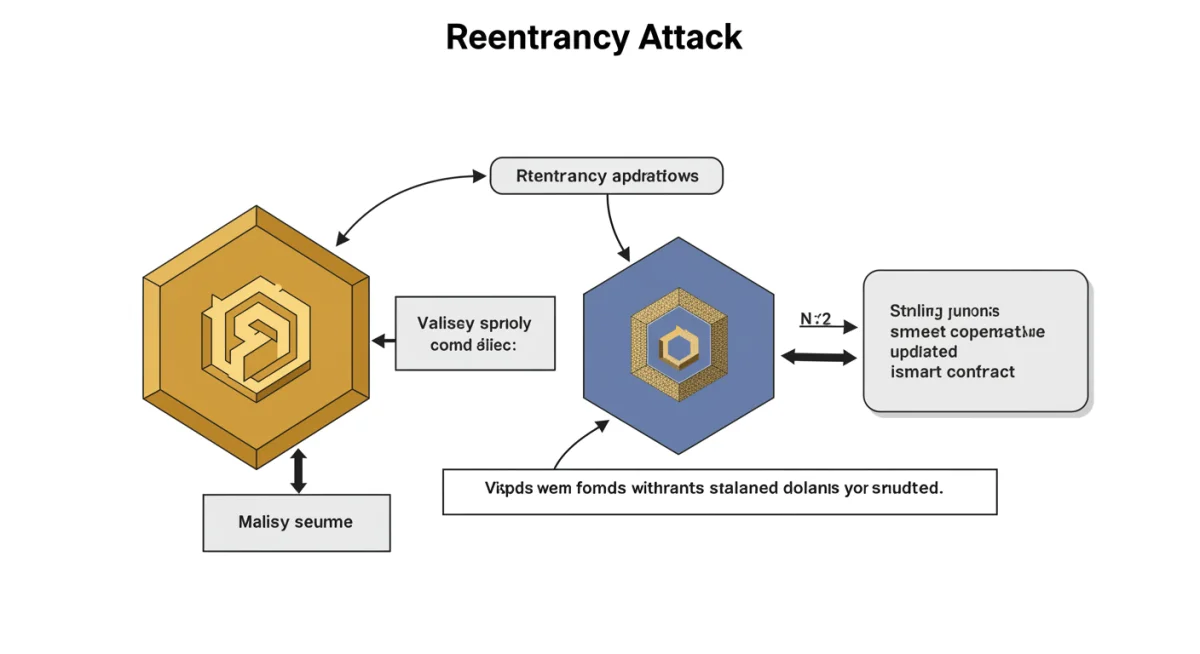
Reentrancy, a vulnerability famously exploited in the 2016 DAO hack, continues to be a significant concern for smart contract security in 2026. This attack occurs when an external call to another contract is made before the current contract’s state variables have been updated, allowing the external contract to call back into the original contract repeatedly. This can lead to funds being drained or other unintended state changes.
Despite being a well-documented issue, reentrancy attacks persist due to developers overlooking its nuances, especially in complex contract interactions or when integrating with external protocols. The challenge lies not just in identifying direct reentrancy but also in recognizing indirect or cross-function reentrancy where multiple function calls can lead to the same vulnerability.
Preventing Reentrancy Through Best Practices
Mitigating reentrancy requires careful design and adherence to secure coding patterns. The primary defense mechanism is the Checks-Effects-Interactions pattern, ensuring all state changes are completed before any external calls are made. This effectively prevents an attacker from re-entering the contract while its state is inconsistent.
- Checks-Effects-Interactions (CEI) Pattern: Always update state variables before making external calls.
- Use of Reentrancy Guards: Implement mutex locks or reentrancy guards to prevent re-execution of a function.
- Minimize External Calls: Reduce reliance on external contracts where possible, or encapsulate such calls carefully.
- Transfer and Send for Ether: When sending Ether, use
transfer()orsend()instead ofcall.value().gas()(), as they limit the gas available to the recipient, preventing complex reentrant calls.
Thorough code reviews and static analysis tools are also essential in identifying potential reentrancy vectors. Developers should prioritize understanding the execution flow of their contracts, particularly when interacting with external contracts, to ensure that state changes are atomic and finalized before control is relinquished. This vigilance is key to preventing one of the most enduring smart contract vulnerabilities.
Access Control Vulnerabilities: Unauthorized Operations
Access control vulnerabilities remain a critical threat in 2026, often leading to unauthorized execution of sensitive functions or manipulation of critical contract parameters. These vulnerabilities arise when a smart contract fails to properly restrict who can call certain functions or modify specific data. This can range from simple ownership checks to complex role-based access control (RBAC) mechanisms.
The complexity often stems from multi-owner or multi-signature schemes, where intricate logic can introduce subtle flaws. Developers might inadvertently expose administrative functions to regular users or fail to revoke permissions effectively, creating backdoors for attackers. As smart contracts govern increasingly valuable assets and processes, the integrity of access control mechanisms is paramount.
Implementing Robust Access Control
Effective access control relies on clear design patterns and rigorous implementation. The most common approach involves using modifiers like onlyOwner or more sophisticated RBAC systems. However, the true challenge lies in ensuring these mechanisms are correctly applied across all sensitive functions and that the roles and permissions are well-defined and managed.
- Explicit Role Definitions: Clearly define roles (e.g., owner, admin, user) and their associated permissions.
- Use of Modifiers: Employ custom modifiers (e.g.,
onlyOwner,onlyAdmin) to restrict function access. - Multi-signature Wallets: For critical operations, implement multi-signature requirements to prevent single points of failure.
- Least Privilege Principle: Grant only the necessary permissions to each role or address.
Furthermore, careful consideration must be given to how ownership or administrative roles can be transferred or revoked. Improper handling of these processes can leave a contract vulnerable to takeover. Regular security audits focusing specifically on access control logic are indispensable for catching these often-overlooked smart contract vulnerabilities before they can be exploited.
Integer Overflow and Underflow: Mathematical Exploits
Integer overflow and underflow vulnerabilities, though well-known, continue to pose a threat in 2026, particularly in contracts handling arithmetic operations on large or small numbers. An overflow occurs when a number exceeds the maximum value a variable type can hold, causing it to wrap around to its minimum value. Conversely, an underflow happens when a number goes below the minimum value, wrapping around to its maximum.
These issues can lead to incorrect calculations of balances, rewards, or other critical figures, often resulting in significant financial losses. While modern Solidity versions include checks for these issues by default for arithmetic operations, developers using older compilers or custom assembly code must remain vigilant. The danger often lies in unchecked external inputs or complex formulas where intermediate calculations might exceed limits.
Safeguarding Against Integer Issues
To effectively mitigate integer overflow and underflow, developers must adopt careful coding practices and leverage available tools. The primary defense is to use safe math libraries, which explicitly check for these conditions and revert transactions if an overflow or underflow would occur. This prevents the unexpected wrapping of values.
- Use SafeMath Libraries: Integrate libraries like OpenZeppelin’s SafeMath for all arithmetic operations.
- Compiler Version Awareness: Understand that Solidity versions 0.8.0 and higher automatically check for overflows/underflows. For older versions, manual checks or SafeMath are crucial.
- Validate Inputs: Always validate external inputs to ensure they fall within expected ranges and prevent manipulation.
- Thorough Testing: Conduct extensive testing with edge cases and extreme values to uncover potential overflow/underflow scenarios.
Beyond technical solutions, a deep understanding of the mathematical logic within smart contracts is essential. Developers should always consider the potential range of values for all variables involved in calculations and how these might interact under various conditions. Proactive measures against these mathematical smart contract vulnerabilities are vital for maintaining financial integrity.
Oracle Manipulation: The Data Integrity Threat
Oracle manipulation has emerged as a significant smart contract vulnerability in 2026, especially for DeFi protocols that rely on external data feeds for pricing, lending rates, or other critical information. Oracles act as bridges between the blockchain and the outside world, but if their data can be manipulated, the entire protocol built upon that data becomes compromised. Attackers can exploit delays, low liquidity, or weaknesses in the oracle’s aggregation mechanism to feed false data to a smart contract, triggering profitable but malicious actions.
The challenge is particularly acute with decentralized oracles, where the aggregation of data from multiple sources is intended to provide robustness. However, even these can be vulnerable if a significant portion of the data providers can be compromised or if the aggregation logic itself has flaws. The financial implications of such attacks can be devastating, as seen in numerous past DeFi exploits.
Fortifying Oracle Security
Mitigating oracle manipulation requires a multi-faceted approach that focuses on decentralization, data source diversity, and robust aggregation mechanisms. Relying on a single oracle or a centralized data feed is a major risk. Instead, protocols should integrate with established, reputable oracle networks that employ cryptographic proofs and economic incentives to ensure data integrity.
- Decentralized Oracle Networks: Utilize reputable decentralized oracle solutions like Chainlink that aggregate data from multiple independent sources.
- Time-weighted Average Prices (TWAP): Implement TWAP oracles in conjunction with spot prices to make price manipulation more expensive and difficult.
- Multiple Oracle Providers: Integrate data from several distinct oracle providers to reduce reliance on any single entity.
- Circuit Breakers and Emergency Shutdowns: Design mechanisms to pause or shut down protocols if extreme price deviations are detected, limiting potential losses.
Developers must also consider the economic incentives of their protocols and how these might be leveraged by an attacker to manipulate oracle data for profit. Regular stress testing of oracle integrations and a deep understanding of their underlying mechanics are crucial for protecting against this advanced class of smart contract vulnerabilities.
Front-Running and Sandwich Attacks: Transaction Order Manipulation
Front-running and sandwich attacks, though not strictly code vulnerabilities, represent critical economic exploits that US developers must consider in 2026. These attacks leverage the public nature of blockchain transactions and the time delay between a transaction being broadcast and its inclusion in a block. A malicious actor can observe a pending transaction (e.g., a large buy order on a decentralized exchange), then submit their own transaction with a higher gas fee to get it included in the block *before* the original transaction (front-running), or both before and after (sandwich attack).
In a sandwich attack, the attacker places an order just before the victim’s transaction to drive up the price, and then another order just after to profit from the price increase caused by the victim’s transaction. These attacks are particularly prevalent in DeFi, especially on decentralized exchanges (DEXs) and lending protocols, where price fluctuations can be significant and easily manipulated by large orders.
Countering Transaction Order Exploits
Mitigating front-running and sandwich attacks is challenging because they exploit the fundamental mechanics of public blockchains. However, several strategies can help reduce their impact. These approaches aim to either obscure the transaction’s intent, reduce the profitability of the attack, or alter the transaction inclusion mechanism.
- Commit-Reveal Schemes: For sensitive operations, users can commit a hash of their action and later reveal the full action, preventing front-running.
- Decentralized Trading Mechanisms: Explore alternative trading designs that don’t rely solely on public mempools, such as batch auctions or private transaction relays (e.g., Flashbots RPC).
- Slippage Tolerance Adjustment: Users can set lower slippage tolerances on DEXs, making sandwich attacks less profitable or causing them to fail.
- Encrypted Transactions: Future blockchain enhancements might include mechanisms for encrypted transactions that only become visible upon inclusion.
While completely eliminating front-running might be difficult given the transparent nature of blockchains, developers can design protocols that are less susceptible to these economic smart contract vulnerabilities. Educating users about optimal gas settings and transaction privacy options also plays a role in reducing the effectiveness of these attacks.
Proactive Security Measures and Auditing for 2026
Beyond understanding individual vulnerabilities, a comprehensive proactive security strategy is essential for US developers in 2026. This involves integrating security throughout the entire development lifecycle, from initial design to post-deployment monitoring. Relying solely on a single audit before launch is no longer sufficient given the dynamic nature of threats and the increasing value locked in smart contracts.
A multi-layered approach that combines automated tools with expert human review and continuous monitoring provides the best defense. The goal is to identify and address potential weaknesses at every stage, making it significantly harder for malicious actors to find and exploit flaws. This commitment to ongoing security is a hallmark of mature blockchain development.
Key Security Practices for Developers
Implementing a robust security framework requires a combination of technical tools, process adherence, and a security-first mindset. Developers should not view security as an afterthought but as an integral part of their engineering discipline. This includes staying updated on the latest exploit vectors and participating in the broader security community.
- Regular Code Audits: Engage reputable third-party auditors for comprehensive security reviews, ideally before major deployments and after significant updates.
- Static Analysis Tools: Utilize automated tools like Slither, Mythril, or Solhint to identify common vulnerabilities and code smells early in the development process.
- Unit and Integration Testing: Implement extensive test suites that cover all possible execution paths, edge cases, and external contract interactions.
- Formal Verification: For highly critical components, consider formal verification to mathematically prove the correctness of contract logic.
- Bug Bounty Programs: Launch bug bounty programs to incentivize white-hat hackers to find and report vulnerabilities before they are exploited.
- Continuous Monitoring: Implement real-time monitoring solutions to detect unusual activity or potential exploits post-deployment.
By embedding these proactive measures into their development workflows, US developers can significantly reduce their exposure to smart contract vulnerabilities, enhancing the security and trustworthiness of their decentralized applications.
| Key Vulnerability | Brief Description |
|---|---|
| Reentrancy | External calls before state updates, allowing repeated execution and fund drains. |
| Access Control | Improper restriction of function calls or parameter modifications, leading to unauthorized actions. |
| Integer Over/Underflow | Arithmetic operations exceeding variable limits, causing incorrect calculations and financial loss. |
| Oracle Manipulation | Feeding false external data to contracts for profit, compromising protocol integrity. |
Frequently Asked Questions About Smart Contract Security
In 2026, emerging smart contract vulnerabilities are likely to focus on cross-chain interaction risks, sophisticated economic exploits, and supply chain attacks targeting dependencies. Attackers will increasingly leverage complex inter-contract logic and oracle manipulation, requiring developers to adopt advanced security paradigms beyond traditional audits.
US developers can best protect against reentrancy attacks by consistently applying the Checks-Effects-Interactions pattern, ensuring state changes are finalized before external calls. Implementing reentrancy guards and using gas-limited Ether transfer methods like transfer() or send() are also crucial. Regular static analysis and thorough code reviews help identify potential vectors.
Preventing oracle manipulation requires integrating with decentralized oracle networks like Chainlink, diversifying data sources, and employing Time-Weighted Average Price (TWAP) mechanisms. Protocols should also include circuit breakers or emergency shutdown functions to mitigate losses if extreme price deviations are detected, safeguarding against compromised data feeds.
Yes, while Solidity versions 0.8.0 and higher automatically check for integer overflows/underflows, these vulnerabilities remain relevant for contracts compiled with older versions or those using custom assembly. Developers must still use safe math libraries or implement explicit checks, especially when dealing with external inputs or complex arithmetic to prevent financial exploits.
Continuous auditing and monitoring are critical for maintaining smart contract security post-deployment. They involve regular third-party security reviews, automated static analysis, and real-time transaction monitoring. This ongoing vigilance helps detect new vulnerabilities, unusual activity, or potential exploits that might arise from evolving threats or unforeseen interactions, ensuring long-term protocol integrity.
Conclusion
The journey of securing smart contracts in 2026 is an ongoing commitment, requiring vigilance, continuous learning, and the adoption of best practices. For US developers, understanding and mitigating the top smart contract vulnerabilities—reentrancy, access control flaws, integer overflows, oracle manipulation, and transaction order attacks—is fundamental to building a robust and trustworthy decentralized future. By embracing proactive security measures, integrating comprehensive auditing, and fostering a security-first mindset, the blockchain ecosystem can evolve more safely, protecting user assets and fostering innovation. The responsibility lies with the development community to stay ahead of malicious actors, ensuring the integrity and reliability of the digital applications that power the next generation of the internet.