Zero-Knowledge Proofs: US Blockchain Privacy & Security Guide 2026

The digital landscape is rapidly evolving, and with it, the demand for robust privacy and security solutions. In this context, zero-knowledge proofs US are emerging as a pivotal technology, promising to revolutionize how data is handled on blockchains. By 2026, these cryptographic marvels are expected to enhance blockchain privacy and security by a remarkable 30%, offering a new paradigm for verifiable, yet private, interactions across various sectors.
Understanding zero-knowledge proofs: a foundational overview
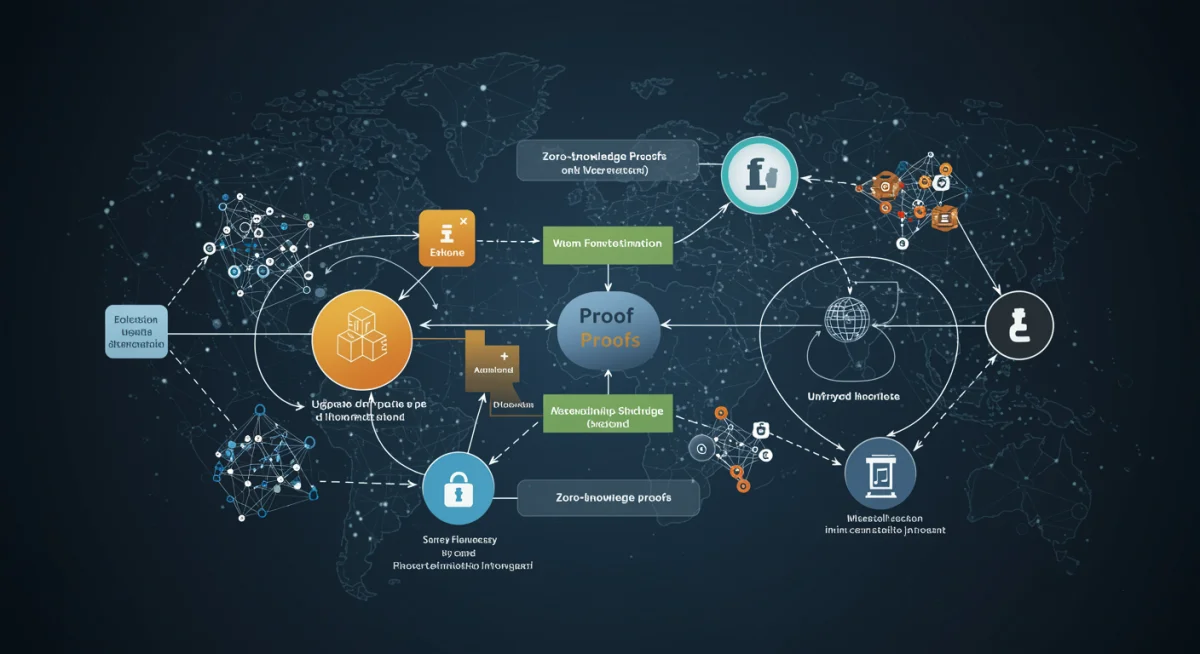
Zero-knowledge proofs (ZKPs) represent a groundbreaking cryptographic primitive that allows one party (the prover) to convince another party (the verifier) that a given statement is true, without revealing any information beyond the veracity of the statement itself. This concept, while seemingly paradoxical, has profound implications for digital privacy.
The core idea behind ZKPs is to decouple the act of proving from the act of disclosing. Instead of sharing sensitive data to prove a claim, a ZKP system generates a mathematical proof. This proof is compact, easily verifiable, and most importantly, reveals nothing about the underlying secret. It’s like proving you know a secret password without ever saying the password aloud.
The three pillars of zero-knowledge proofs
For a cryptographic protocol to be considered a true zero-knowledge proof, it must satisfy three essential properties:
- Completeness: If the statement is true, an honest prover can always convince an honest verifier.
- Soundness: If the statement is false, a dishonest prover cannot convince an honest verifier, except with a negligible probability.
- Zero-Knowledge: If the statement is true, the verifier learns nothing beyond the fact that the statement is true. They gain no additional information about the secret itself.
These properties ensure that ZKPs are both reliable and privacy-preserving. The verifier can trust the proof without needing to access or store any sensitive data, which is a critical advantage in an era of increasing data breaches and privacy concerns. This fundamental understanding sets the stage for exploring their transformative potential in blockchain technology.
The privacy imperative: why ZKPs are crucial for US blockchain adoption
In the United States, the adoption of blockchain technology has been met with both enthusiasm and apprehension, particularly concerning data privacy. Traditional blockchain designs, while transparent, often expose transaction details and participant identities, which can be a significant hurdle for enterprises and individuals alike. This is where zero-knowledge proofs step in as a game-changer.
The ability of ZKPs to enable verifiable confidentiality directly addresses many of the privacy concerns that have hindered widespread blockchain adoption in sensitive sectors. For instance, financial institutions are hesitant to move transactions onto public blockchains due to regulatory mandates and the need to protect client data. ZKPs allow these institutions to prove compliance or the validity of a transaction without exposing sensitive financial records.
Addressing regulatory challenges with ZKPs
US regulatory bodies, such as the SEC and FinCEN, often require detailed reporting and auditing capabilities. ZKPs can facilitate this by enabling proofs of compliance without revealing the underlying data to unauthorized parties. This delicate balance between transparency for regulators and privacy for users is a critical area where ZKPs offer a viable solution.
- HIPAA compliance: In healthcare, ZKPs can enable secure sharing of medical data for research or insurance claims without exposing individual patient records.
- GDPR and CCPA alignment: While US-centric, the principles of these global privacy regulations resonate domestically. ZKPs help by minimizing data exposure, aligning with data minimization principles.
- Financial privacy: Businesses can prove solvency or transaction legitimacy without revealing trade secrets or customer identities to competitors or the public.
The privacy-enhancing capabilities of ZKPs are not merely a technical advantage; they are a strategic necessity for fostering trust and accelerating blockchain integration across the diverse and highly regulated US economy. Their role in bridging the gap between public ledger transparency and individual data privacy is indispensable for future growth.
Enhancing blockchain security: how ZKPs fortify digital trust
Beyond privacy, zero-knowledge proofs offer substantial improvements to blockchain security. By allowing verifications without data exposure, ZKPs reduce the attack surface for malicious actors and enhance the overall integrity of decentralized systems. This fortification of digital trust is paramount for the long-term viability and scalability of blockchain applications.
One of the primary security benefits comes from minimizing the amount of sensitive information stored or transmitted. In traditional systems, every piece of data shared is a potential vulnerability. ZKPs eliminate this by enabling proofs of knowledge or computation without revealing the data itself. This significantly reduces the risk of data breaches and identity theft, which are growing concerns in the digital age.
Reducing transaction fraud and increasing integrity
ZKPs can be integrated into blockchain transactions to prove the legitimacy of operations without revealing details that could be exploited. For instance, in a voting system, a ZKP could prove that a user is eligible to vote without revealing their identity, and that their vote is valid without revealing their choice. This adds a layer of verifiable integrity that is difficult to achieve with other methods.
Furthermore, ZKPs can enhance the security of smart contracts. By allowing computations to be verified off-chain with a ZKP, and only the proof submitted to the blockchain, the complexity of on-chain operations can be reduced. This not only improves efficiency but also minimizes the potential for vulnerabilities within the smart contract code itself, as less sensitive logic needs to be directly exposed.
- Authentication without identification: Users can authenticate themselves to a service without revealing their identity or credentials.
- Fraud prevention: Prove eligibility for a service or transaction without exposing personal financial details.
- Scalability and efficiency: Off-chain computation with ZKPs reduces the data load on the main chain, improving transaction throughput and network performance.
The security advantages offered by ZKPs are multifaceted, ranging from enhanced data protection to bolstering the integrity of complex blockchain operations. As the US moves towards a more interconnected digital economy, these security enhancements will be critical for building widespread confidence in blockchain technology.
Key ZKP implementations and their impact on US industries by 2026
By 2026, the impact of zero-knowledge proofs is expected to be felt across a multitude of US industries, transforming how businesses operate and interact with data. Their ability to deliver both privacy and verifiable security makes them ideal for sectors grappling with sensitive information and complex regulatory environments.
The financial sector is perhaps one of the most immediate beneficiaries. With ZKPs, banks and other financial institutions can conduct secure and private transactions on public blockchains, enabling new forms of inter-bank settlements and compliance reporting. This could lead to more efficient and cost-effective financial operations, while still adhering to stringent privacy laws.
Healthcare and supply chain transformations
In healthcare, ZKPs can facilitate secure data sharing for research, drug development, and patient record management without compromising individual privacy. This opens up possibilities for more collaborative and innovative medical advancements. Similarly, in supply chain management, ZKPs can verify the authenticity of products, ethical sourcing, and compliance with regulations without revealing proprietary business information to competitors.
The government sector also stands to gain significantly. ZKPs can be used for secure digital identity solutions, enabling citizens to prove their eligibility for services without disclosing excessive personal data. This could streamline government processes, reduce fraud, and enhance citizen privacy in interactions with public services.
- Financial services: Private asset transfers, compliant DeFi, and secure interbank communication.
- Healthcare: Secure patient data sharing, verifiable clinical trials, and privacy-preserving insurance claims.
- Supply chain: Verifiable product provenance, ethical sourcing proofs, and cold chain integrity.
- Digital identity: Anonymous authentication, age verification, and credential validation.
The broad applicability of ZKPs means they are not confined to a single niche but are poised to become a foundational technology enabling a new generation of private and secure digital services across the US economy.
Navigating the technical landscape: challenges and opportunities for ZKP development
While the promise of zero-knowledge proofs is immense, their widespread adoption and deployment in the US also present a unique set of technical challenges and opportunities. Developing and implementing ZKPs requires specialized cryptographic expertise and careful consideration of computational resources.
One of the primary challenges lies in the computational intensity of generating ZKPs. While verification is typically fast, creating a proof can be resource-intensive, especially for complex statements. This computational overhead needs to be optimized for real-world applications to be practical and scalable. Ongoing research is focused on developing more efficient ZKP schemes, such as zk-SNARKs and zk-STARKs, which aim to reduce proof generation time and size.
Standardization and interoperability
Another significant opportunity lies in the standardization of ZKP protocols. For ZKPs to be truly impactful, there needs to be greater interoperability between different blockchain platforms and applications. Developing common standards and best practices will be crucial for fostering a cohesive ecosystem where ZKPs can be seamlessly integrated.
The US academic and research communities are at the forefront of these developments, continuously pushing the boundaries of cryptographic innovation. Funding for ZKP research from government agencies and private enterprises is vital for overcoming current limitations and unlocking the full potential of these technologies. Furthermore, the development of user-friendly tools and libraries will lower the barrier to entry for developers, accelerating adoption.
- Research and development: Focus on optimizing proof generation and verification efficiency.
- Tooling and infrastructure: Create accessible SDKs and libraries for easier ZKP integration.
- Education and talent: Cultivate a workforce skilled in advanced cryptography and ZKP implementation.
- Regulatory clarity: Collaborate with policymakers to establish clear guidelines for ZKP usage in regulated industries.
Addressing these technical hurdles and capitalizing on development opportunities will be key to realizing the projected 30% enhancement in blockchain privacy and security by 2026, solidifying the US’s position as a leader in cryptographic innovation.
The future outlook: ZKPs and the evolving US digital economy by 2026
Looking ahead to 2026, zero-knowledge proofs are not just a technological advancement; they represent a fundamental shift in how the US digital economy will operate, prioritizing privacy, security, and trust. Their integration into blockchain ecosystems will pave the way for novel applications and business models that were previously impossible due to privacy concerns.
The widespread adoption of ZKPs will foster a more secure and confidential digital environment, encouraging greater participation from both individuals and enterprises. This will likely lead to an explosion of innovation in areas such as decentralized finance (DeFi), digital identity management, and secure data marketplaces, all built upon the bedrock of verifiable privacy.
Impact on digital identity and privacy-preserving AI
One of the most exciting prospects is the evolution of digital identity. ZKPs enable self-sovereign identity solutions where individuals have complete control over their personal data, only sharing what is absolutely necessary for verification. This empowers users and reduces the reliance on centralized intermediaries, offering a more robust and privacy-centric approach to online interactions.
Furthermore, ZKPs could play a crucial role in the development of privacy-preserving artificial intelligence. By allowing AI models to train on encrypted data or verify computations without seeing the raw inputs, ZKPs can help address ethical concerns surrounding data usage in AI, fostering greater trust in intelligent systems. This convergence of ZKPs, blockchain, and AI will unlock unprecedented opportunities for secure and intelligent applications across the US.
- Decentralized finance (DeFi): Enabling private transactions and compliant institutional participation.
- Web3 evolution: Powering a new generation of privacy-centric decentralized applications.
- Data monetization: Creating secure marketplaces for data without compromising privacy.
- AI/ML privacy: Facilitating secure and ethical AI model training and deployment.
By 2026, the strategic implementation of zero-knowledge proofs will not only enhance blockchain privacy and security by 30% but will also redefine the parameters of trust and confidentiality in the US digital economy, setting a global benchmark for secure and private digital interactions.
| Key Aspect | Brief Description |
|---|---|
| Privacy Enhancement | ZKPs allow verification of data or computations without revealing the underlying sensitive information. |
| Security Fortification | Reduces attack surface by minimizing data exposure, enhancing integrity of blockchain transactions and smart contracts. |
| US Industry Impact | Transforming finance, healthcare, supply chain, and digital identity by enabling compliant and private operations. |
| Future Outlook | Paving the way for a more secure, private, and trustworthy US digital economy, driving innovation in DeFi and AI. |
Frequently asked questions about zero-knowledge proofs
Zero-knowledge proofs are cryptographic protocols allowing one party to prove the truth of a statement to another, without revealing any information beyond the statement’s validity. This ensures privacy while maintaining verifiability, crucial for sensitive data on public blockchains.
ZKPs enable transactions and data verification on blockchains without exposing underlying sensitive details like identities or transaction amounts. This is vital for US industries like finance and healthcare, ensuring regulatory compliance and protecting user data.
ZKPs reduce the risk of data breaches by minimizing information exposure. They fortify digital trust by allowing secure authentication and verifiable transaction integrity, making blockchain systems more resilient against various cyber threats.
By 2026, ZKPs are expected to see significant adoption in financial services for private transactions, healthcare for secure patient data, supply chain management for verifiable provenance, and digital identity solutions across various sectors in the US.
Yes, ZKP generation can be computationally intensive, requiring ongoing research to improve efficiency. Challenges also include standardization across platforms and developing user-friendly tools to accelerate their integration into diverse applications.
Conclusion
The journey toward a more secure and private digital future in the US is undeniably being shaped by the advancements in zero-knowledge proofs. As we approach 2026, the projected 30% enhancement in blockchain privacy and security through ZKPs underscores their transformative potential. This cryptographic innovation is not merely about technical sophistication; it’s about building a foundation of trust and confidentiality that will empower individuals, revolutionize industries, and redefine our interaction with digital information. The ongoing research, development, and strategic implementation of ZKPs will be crucial in realizing this vision, ensuring that the US remains at the forefront of the evolving digital economy.